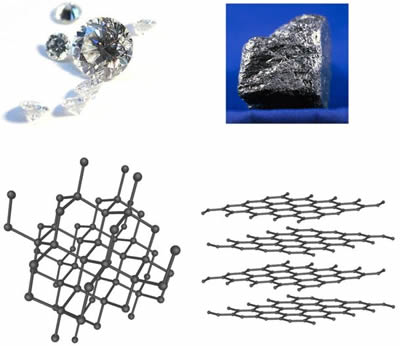
The low density 2 26 g cm 3 of graphite is due to large distance between different layers of carbon atoms.
Uses of diamond and graphite in chemistry.
The chemical properties of synthetic and natural diamonds are the same.
Synthetic diamonds are widely used in industry in cutting and grinding tools.
This lesson describes the relationship between the structure and function of the giant covalent substances graphite and diamond.
Makes diamond useful for cutting tools such as diamond tipped glass cutters and oil rig drills.
Diamonds so prepared are called synthetic or artificial diamonds.
Graphene a naturally occurring ingredient in graphite has unique physical properties and is one of the strongest known substances.
Diamond is a solid form of pure carbon with its atoms arranged in a crystal.
These minerals in general are known to be as polymorphs having the same type of chemistry but of the various crystalline structures.
Diamond has a tetrahedral structure where as graphite has an hexagonal arrangement.
Diamonds usually have eight sides forming double pyramids.
Graphite has a giant covalent structure in which.
Graphite is insoluble in water and organic solvents for the same reason that diamond is insoluble.
The dispersion of graphite in oil is known as oil dag and in water is known as aqua dag.
When you use a pencil sheets are rubbed off and stick to the paper.
Graphite is used as lubricant either as a powder or as a dispersion in oil or water.
Some have six sides and they form cubes.
Mixed with clay it is used in lead pencils.
Graphite is a stable form of naturally occurring carbon also known as plumbago blacklead or mineral carbon.
Carbon atoms in diamond form a tetrahedral arrangement properties and uses.
Both are made of carbon atoms entirely.
The rigid network of carbon atoms held together by strong covalent bonds makes diamond very hard.
Diamond and graphite are allot ropes of each other.
Solid carbon comes in different forms known as allotropes depending on the type of chemical bond.
Attractions between solvent molecules.
The two most common allotropes of pure carbon are diamond and graphite in graphite the bonds are sp 2 orbital hybrids and the atoms form in planes with each bound to three nearest neighbors 120 degrees apart.
Graphite is mostly used for refractory battery steel expanded graphite brake linings foundry facings and lubricants.
Diamond and graphite both are known as the allotropes of carbon.
Graphite has a lower density than diamond.